
Mars Needs Eyeballs
Extraordinary hypotheses are worth testing if the needed experiments are extraordinarily cheap


Although I wholeheartedly embrace the key arguments in Avi Loeb’s classic post “Extraordinary Evidence Requires Extraordinary Funding,” I reject the title claim. Sometimes it’s true, but sometimes it’s not. For example, my current work transmogrifying vaccines into beer is a good example of cheap-but-extraordinary evidence. The whole point of the project is how cheap it is.
The first step in obtaining extraordinary evidence is identifying an important question. The second step is to creatively imagine which available explanations can best account for the existing pool of evidence, and then develop strategies for experimentally testing the predictions of each of the competing hypotheses.
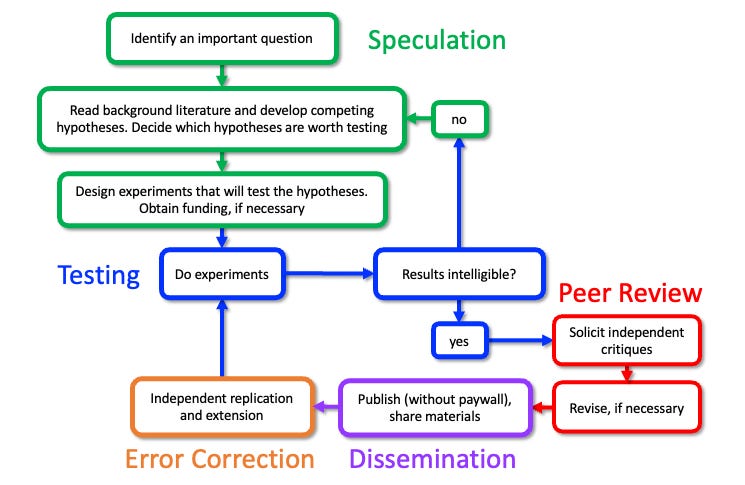
Deciding which hypotheses to test is the step where the funding issue carries the most weight. If the most enticing hypothesis on the table costs a billion dollars to test - but there are also some extraordinary explanations that could easily be ruled out in an afternoon - then a wise scientist might first scratch the cheap-to-test hypotheses off the list before going down on bended knee to beg for extraordinary funding.
Which brings us to Mars. Loeb has estimated that Atlas has a minimum mass of 30 billion tons, but it’s hard to know whether its mass could be significantly greater than that. An extraordinary (but technically plausible) hypothesis is that Atlas could be a cooled neutron star. Since neutron stars are often highly magnetic, it would comport with the hypothesis that some of Atlas’s anomalies could be accounted for by the presence of a strong magnetic field. A testable prediction is that when the hypothetical neutron star passed close to Mars, it would have bent Mars’s orbit. The needed experiment is dirt cheap - somebody with a telescope just needs to have a quick look to be sure Mars is still exactly where it’s supposed to be.
Neutron stars are typically a little more massive than the Sun. If a collapsing star were an order of magnitude smaller than the Sun, there wouldn’t be enough gravity to keep the neutrons compressed and the core would quickly decay into protons and electrons and go back to the density of ordinary matter. My layman’s sense is that it might be possible to hand-wave some kind of dark matter hocus-pocus that could hold a planet-mass object together in a compressed neutron-rich state. In a thought experiment where an object with the mass of the Earth had passed Mars at 30 million kilometers, my AI tells me Mars’s orbit would have shifted by a barely detectable amount. If Mars is still exactly where we think it should be then it will cheaply rule out the extraordinary hypothesis of planet-sized masses.
Song of the day:
We just need to get rid of the word "extraordinary" when describing hypotheses. It's not helping anything.
(impact if true) * (probability of it being true) = value of testing
Potential high value outcomes are worth high costs of testing, but if you can find a cheap way to test it, even better.